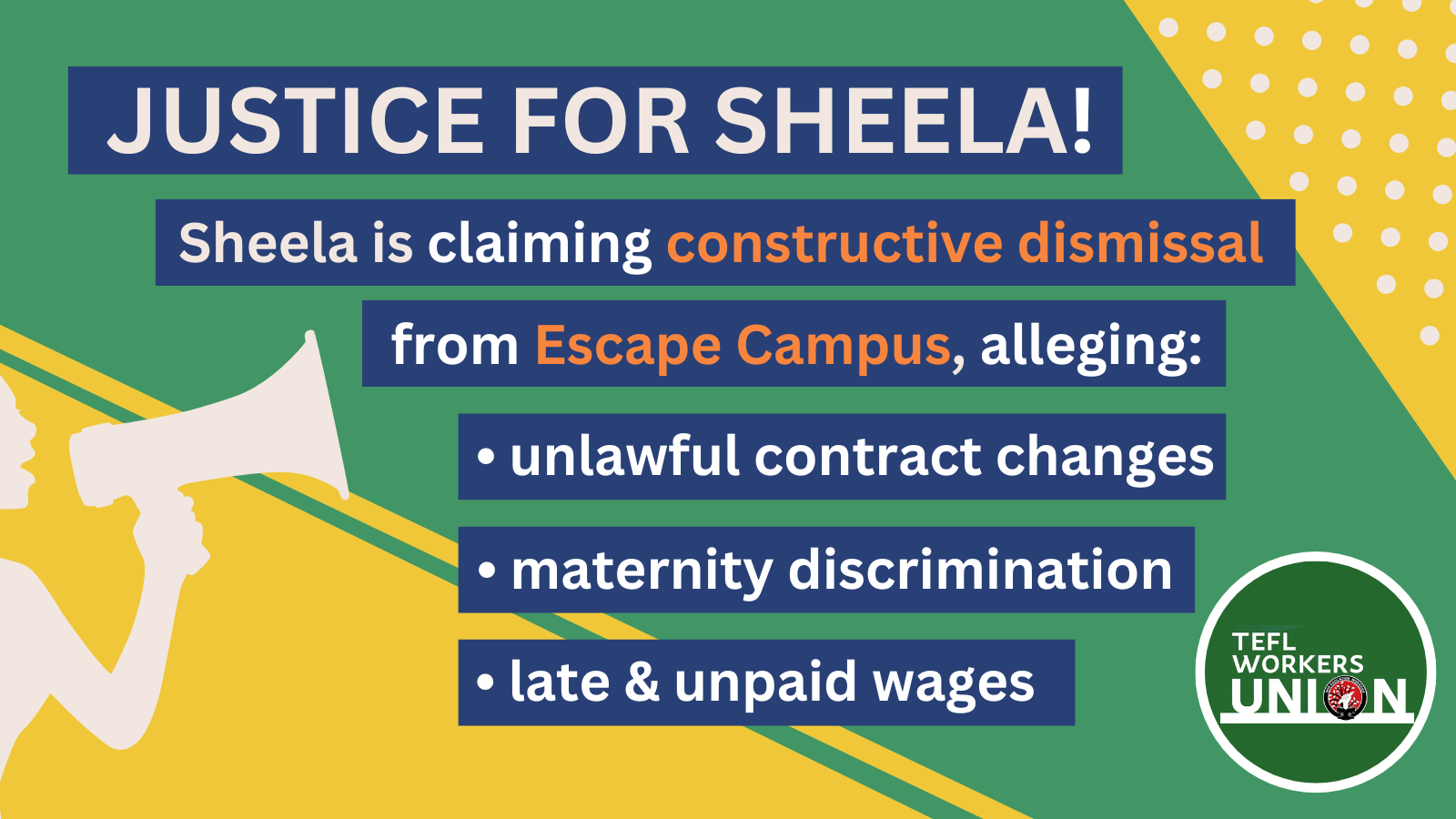
A former employee of Escape Campus is claiming constructive dismissal on the grounds of contractual breach, late and missing pay and maternity discrimination.
Sheela* worked at Escape Campus, also known as Verbo English, for years under contracted part-time hours. She returned from maternity leave to her job at the Bloomsbury-based school expecting to resume her previous role. She alleges, however, that she was not provided with the hours stated in her contract, administrative tasks were not included in her payslip and, when payments were made, they were regularly late.
Reflecting on how she’s been treated she said, “I love my job and I love my students — but after returning from maternity leave, I was given fewer hours, lower pay, and denied the rights I’m legally entitled to.”
Contract violations, underpayment, and variable hours are all-too-common practices across the English language teaching sector. Tom Liebewitz, the lead organiser for the TEFL Workers’ Union, had this to say:
“Escape, through its many corporate guises, is known as a bad player amongst London schools. It employs many teachers on questionable self-employed contracts and has previously lost a tribunal for religious discrimination. But we’re here to hold even the worst TEFL employers to account. We’re not going away until Escape does right by Sheela.”
The union reached out to Escape and given them the opportunity to make things right. Unfortunately, Escape bosses neglected to take this opportunity so the union has begun a public campaign.
Sheela believes union support is vital for TEFL workers:
“This isn’t just about me — it’s about how working mothers are treated across the sector. No one should be punished for having a child. I’m speaking out to hold Escape accountable — and to demand better for all of its staff.”
Keep up to date by following the TEFL Union on Twitter/X and Bluesky and sign up for the newsletter (link at bottom right).
If you work in TEFL and want to help with campaigns, join today.
*A pseudonym used to protect the worker’s identity.
It’s astonishing that the previous limited company was closed down, yet the same individuals were able to establish a new limited company while leaving behind nearly £1 million in unpaid debts to HMRC and other creditors.
While the current system may legally permit such a restart, it explicitly prohibits directors with outstanding liabilities from having significant control or involvement in the new entity — which appears to be exactly what is happening. Despite multiple reports, HMRC has shown little interest in investigating or intervening.