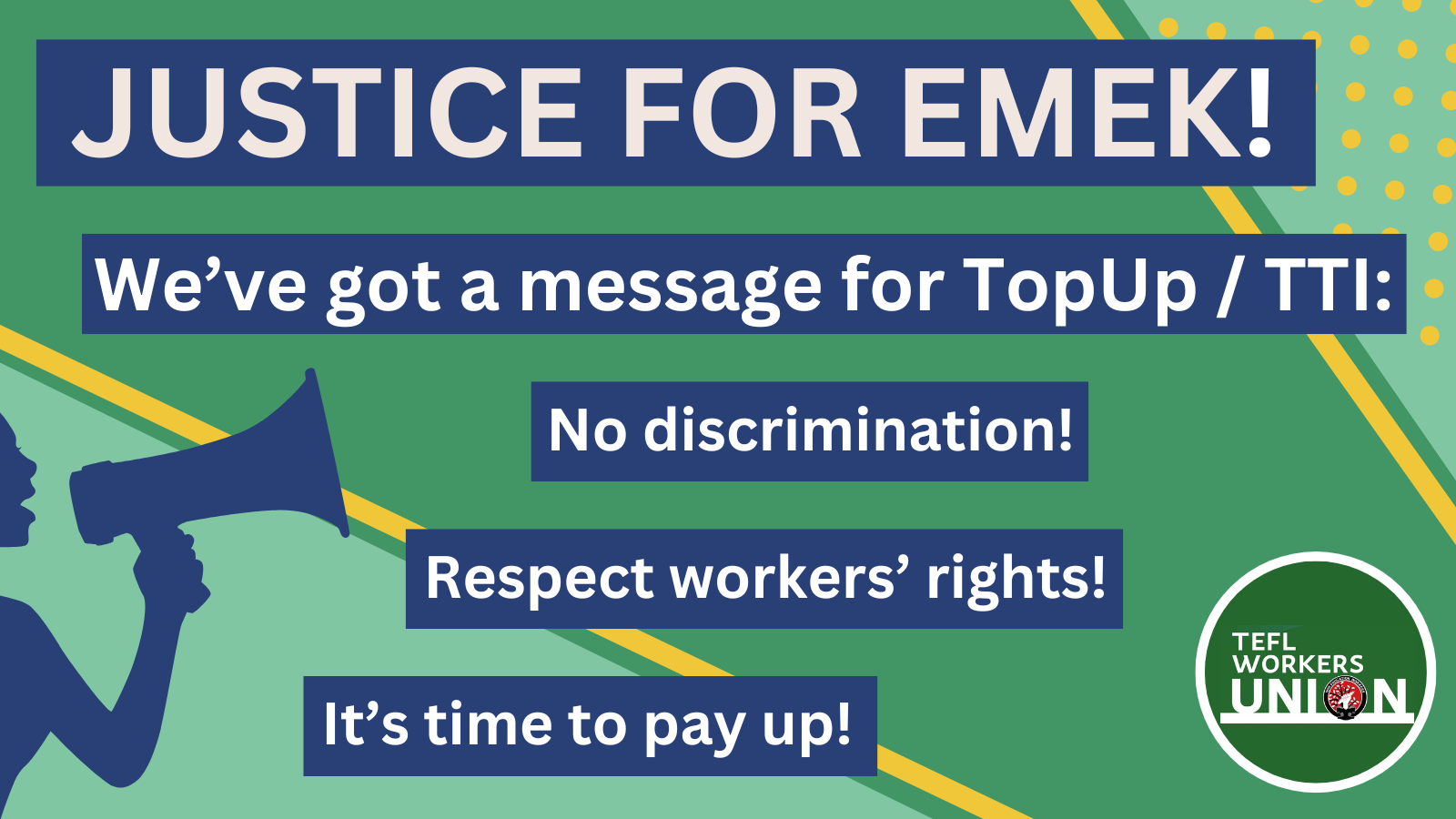
Emek worked at TopUp Learning / TTI English school in Camden in London, a dedicated teacher who was well-liked by students and workmates alike. But her employment recently came to an end, something she believes is due to the fact her first language is Turkish. Below she lays out her allegations about how she was treated in the months leading up to her departure from the company.
The TEFL Workers’ Union is actively supporting Emek and will be keep members and supporters informed of actions they can take to show their support as well.
When “Not Fitting In” Becomes a Workplace Problem
I have been an English teacher for over 20 years. I am Turkish, and English is not my first language. For many of my students, that has never been a weakness. In fact, it has often been one of my strengths. I know what it means to learn English from the inside: the fear, the accent anxiety, the grammar panic, and the emotional effort of trying to express yourself in another language.
But in parts of the English language teaching industry, there is still a damaging belief that the best English teacher must be a “native speaker”. That belief is not justoutdated. It can affect careers, confidence and livelihoods.
My experience at TTI / TopUp Learning made me think seriously about how non-native English-speaking teachers are treated, especially when nationality, accent, race and commercial pressure come together.
During my time at the school, I worked hard, taught IELTS and EFL, supported students, prepared materials, and built strong relationships with learners. Yet over time, I became concerned that my Turkish background and non-native teacher identity were being treated as a problem.
One incident involved a prospective student’s family asking whether the class teacher could be guaranteed to be a “Native English Speaker” after meeting me. Rather than this being treated as a client preference that raised equality concerns, it became part of an allegation against me. I was accused of interfering with the sales process and contributing to possible financial loss, although the evidence I have seen does not show that I discussed fees, enrolment, private lessons or sales terms.
There was also another incident involving a prospective Saudi student and agency, where I was told that concerns had been raised because I was Turkish. I believe full disclosure around that incident is essential. If a client or agency expresses prejudice against Turkish people, the employer’s role should be to protect the worker, not treat the worker as the problem.
Later, I was told that the company could not continue with me. I understood that I had been dismissed, or that the decision had already been made. After that, there were discussions about agreed wording, references, settlement, payment and what others should be told. When I challenged the settlement offer, gross misconduct was then raised.
The allegations included providing IELTS materials, a birthday cake issue, and directing students to management about class arrangements. I strongly dispute that these matters amounted to gross misconduct.
This is why union support matters so much. When you are isolated, under pressure, and being pushed to accept an employer’s version of events, it is very easy to doubt yourself. Union advice helps you slow down, document everything, and understand that procedure, fairness and dignity at work matter. It also reminds you that what feels personal is often structural. If this can happen to one teacher, it can happen to others too.
I am proud to be a Turkish English teacher. I am proud to be a non-native English-speaking teacher. Our value should not be defined by someone else’s prejudice.
Shame on TopUp Learning / TTI English school, Camden, management.
Solidarity with Emek.